
Choosing a logger for several pipe temperatures
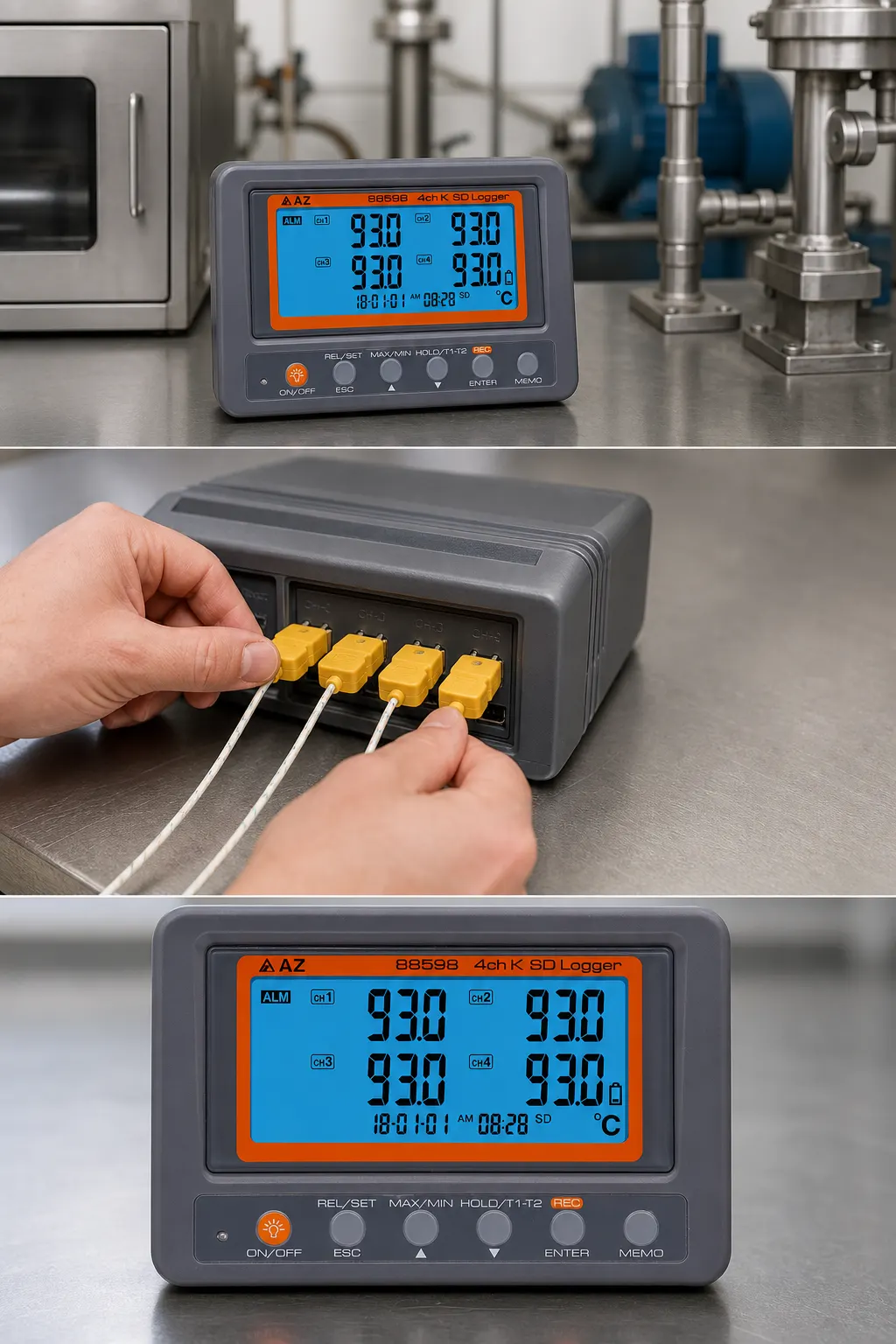
If you need a multi channel pipe temperature logger UK engineers can use to follow several temperatures at once, start by matching the complete measurement setup to the plant-room job. This four-channel K-type thermometer can log at a programmable sampling rate from one second upwards and is described as an SD card datalogger. However, the set includes only two K-type thermocouple probes, so it is not a complete four-probe pipe-monitoring kit as supplied. Before buying, confirm how many points you must record, whether the probes suit those pipe surfaces and how the instrument will be powered.
The main reason to consider four channels is timing. Readings taken from separate pipes several minutes apart do not necessarily describe the same stage of a heating cycle. Four channels give you the capacity to observe related points concurrently, provided you have suitable probes for every channel you intend to use. In a boiler or heating plant room, that could help you build a more coherent temperature record than repeatedly moving a single probe. The important buying decision is therefore not simply whether the instrument has four inputs, but whether the full probe, attachment, power and logging arrangement fits the planned investigation.
Setting up the measurement job in a UK plant room
Define the plant-room question before assigning channels. You might need to understand how two pipe locations behave over an operating period, or you might require three or four simultaneous points. Write down the required locations and the length of the recording period before selecting equipment. This prevents a common mismatch: buying a four-channel instrument but discovering that the supplied two-probe set cannot cover the planned arrangement. The published information confirms four channels and two included K-type probes, but it does not identify the probes’ construction, attachment method or intended surface.
The logger must also remain in an environment within its documented limits. Its stated operating temperature is 0°C to 50°C, with operating humidity below 80%. Those figures apply to the instrument and should not be confused with the temperature at the probe tip. Position the main unit where it is not exposed to plant-room heat or humidity beyond those limits, while allowing the probe leads to reach their measurement points. The stated storage conditions are -20°C to 50°C and below 90% humidity, which matter when the logger is kept in a van, workshop or equipment store between jobs.
Checking channels, probes and pipe contact
The instrument is described as a four-channel K-type thermometer, so it provides capacity for four K-type measurements. The package description names two K-type thermocouple probes. If your plant-room plan requires four monitored points, expect to source two additional suitable probes and verify their compatibility before starting. Do not assume that every K-type probe will be appropriate for every pipe. The public information does not state the supplied probes’ shape, connector details, lead length, surface attachment method or individual temperature limits.
Pipe measurement depends on more than the thermometer’s headline range. The listed K-type instrument range is -200°C to 1370°C, with a resolution of 0.1°C or °F, but that does not establish that the included probes can be used across the whole range. For heating pipework, check that each intended probe is designed for surface contact and can be attached consistently at the chosen point. Also consider whether insulation, curved surfaces or nearby fittings will prevent stable contact. These are setup checks rather than documented capabilities of the included probes, so they should be confirmed rather than inferred from the instrument range.
Matching the sampling interval to the heating cycle
The published sampling rate is programmable from one second upwards. That gives you scope to choose an interval suited to the event you are trying to observe instead of automatically recording at the fastest rate. In a plant room, begin by estimating how quickly the relevant temperatures are likely to change and how long the logger will remain in position. A one-second interval may produce much denser records than a long observation needs, while an interval that is too wide could make a short temperature change harder to see.
A practical approach is to perform a short supervised run before leaving the setup for a longer period. Confirm that every intended channel is producing a plausible response, choose a sampling interval that represents the operating cycle adequately, and note the start time and channel locations. The product is identified as an SD card datalogger, but the public information does not state card capacity, included storage media, file format or software requirements. Check those points if your work depends on transferring readings into a particular spreadsheet, reporting system or customer document.
Planning battery or adaptor power for the recording period
Power arrangements deserve the same attention as probe placement. The logger can use AA batteries, which are stated to be included in the set, or a 9V adaptor, which is not included. The published details do not give expected battery runtime, so the appropriate choice depends on the intended recording period and the condition of the batteries. Do not calculate an unattended duration from an assumed battery life. For an important plant-room run, establish the power plan before attaching probes and starting the log.
If you prefer mains power for a stationary recording, allow for the separate 9V adaptor and verify that it is suitable for the instrument before use. The listing does not provide adaptor specifications beyond the 9V reference. Position the logger and any power lead so that the setup can remain undisturbed and the instrument stays within its operating limits. The beeper and LED alarm named in the product description may be relevant to your setup, but the public information does not explain alarm configuration or behaviour, so do not rely on it as a substitute for checking the recorded channels.
Recognising specification gaps and unsuitable jobs
This logger should not be selected solely because its stated temperature range is broad. The published accuracy bullet mentions accuracy but does not provide an actual accuracy figure. There is also no stated calibration documentation in the available product information. If your plant-room work requires a defined uncertainty, traceable calibration record or evidence for contractual compliance, obtain the missing information before purchase. A 0.1°C display resolution describes how finely the reading is shown; it does not, by itself, establish measurement accuracy.
It may also be the wrong package when you need four ready-to-attach pipe probes immediately, because only two K-type probes are named as included. It is not a sound choice for placing the main instrument where temperatures exceed 50°C, fall below 0°C or humidity reaches 80% or more. Nor should you assume that it is an infrared thermometer merely because the public category path includes infrared thermometers: the actual title and description identify a K-type thermocouple thermometer. Base the decision on the documented K-type inputs and datalogger description rather than the broad category label.
Using a pre-run plant-room checklist
Use this working checklist before beginning the job. Size and access: decide where the main unit can sit and remember that the stated LCD size is 47 x 104mm, while the overall instrument dimensions are not provided. Surface: identify each pipe surface and confirm that the selected probes and attachment method suit it. Setup: allocate each required point to one of the four channels and remember that only two probes are named in the set. Content: check the SD card arrangements, recording interval and any file-handling requirements that matter to your reporting process.
Continue the checklist with environment, power and aftercare. Environment: keep the instrument itself between 0°C and 50°C and below 80% humidity during operation. Power: choose the included AA batteries or obtain and verify an appropriate 9V adaptor, noting that the adaptor is not included. Pre-run check: watch all connected channels during a short supervised test and record which probe is connected to each channel. Aftercare: store the instrument between -20°C and 50°C and below 90% humidity, and keep probes identified so the same channel plan can be reproduced in the workshop or plant room.
Taking the next step before selecting the logger
Turn your intended plant-room test into a simple requirement sheet. State the number of simultaneous points, the pipe surfaces involved, the likely temperatures, the recording duration, the preferred sampling interval and the available power. Then compare that sheet with the documented facts: four K-type channels, two included K-type probes, sampling from one second upwards, SD card datalogger description, AA battery power or an optional 9V adaptor, and the specified operating environment. Any requirement that is not covered by those facts needs a separate compatibility check.
For a two-point investigation, the supplied probe count may align with the number of locations, subject to confirming probe form and attachment suitability. For a three- or four-point setup, include additional compatible probes in the plan rather than treating them as an afterthought. If accuracy documentation, calibration status, storage-media details or adaptor specifications are important to the job, resolve those gaps before relying on the instrument. That final check is what separates a useful multi-channel temperature record from a failed plant-room visit caused by missing probes, unsuitable contact, inadequate power or assumptions the published details do not support.