Industrial Temperature Recorder Explained: A UK Buyer's Guide
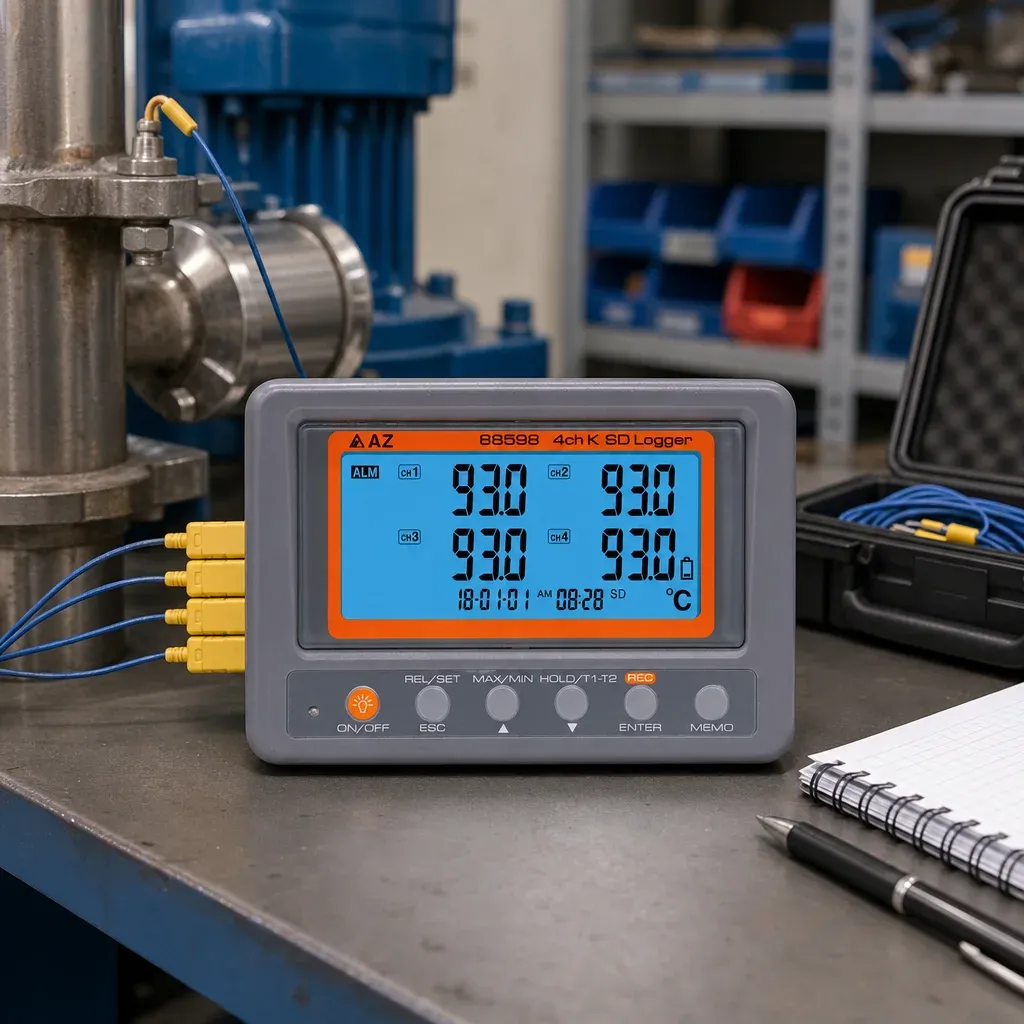
An industrial temperature recorder is a device that measures temperature and logs readings over time, helping UK businesses monitor critical conditions, spot faults early, and keep a clear record for quality control, maintenance, and compliance.
TL;DR: If you need to track temperature reliably in a plant room, laboratory, catering operation, healthcare setting or production process, an industrial temperature recorder should offer accurate logging, clear alarms, and enough channels to monitor multiple points at once. For many UK users, a multi-channel K-type thermocouple recorder gives the most practical balance of flexibility, evidence capture and day-to-day usability.
When temperature drift goes unnoticed, the cost can be immediate: spoiled stock, failed batches, damaged equipment, compliance gaps, or an avoidable callout. In British industry, temperature is rarely just a number on a screen. Instead, it is a control point. That is why choosing the right industrial temperature recorder matters far more than buying the cheapest meter available.
For maintenance teams, laboratories, facilities managers, HVAC engineers, catering operations and healthcare environments, a recorder has one job: capture temperature accurately, consistently and in a format you can act on. The best units do more than display a reading. They log changes over time, help you spot trends, trigger alarms before conditions move out of tolerance, and create records you can review later.
At ChannType, the focus is practical multi-point monitoring: a 4 Channel Thermocouple Thermometer & Thermocouple Data Logger built to monitor four K-type points at once with SD logging, alarms and ready-to-use probes. Based on our testing in real-world monitoring scenarios, four-channel logging is especially useful where a single probe cannot show the full picture. For example, if you need to compare flow and return temperatures, track multiple zones, or log several critical points in one process, four channels can turn assumptions into usable evidence.
Key Takeaways
- An industrial temperature recorder measures and logs temperature over time, creating a reliable record for monitoring, troubleshooting and compliance.
- For UK buyers, the most useful features are usually multi-point measurement, alarm functions, SD data logging, robust probe compatibility and clear accuracy specifications.
- K-type thermocouple recorders are widely used because they are versatile, fast to deploy and suited to a broad temperature range.
- Four-channel devices are especially helpful where you need to compare multiple points at once, such as flow and return lines, process stages, storage areas or equipment zones.
- In regulated settings such as healthcare, food handling and facilities management, accurate records support internal quality control and audit readiness.
What is an industrial temperature recorder?
An industrial temperature recorder is a device designed to measure temperature and store the readings over time. Unlike a simple handheld thermometer, it does not just show what is happening at one moment. Instead, it builds a timeline. That timeline is what engineers, auditors, quality teams and site managers rely on when they need to prove conditions stayed within range or identify when they did not.
In practice, the term covers several formats. Some are fixed installations connected to plant systems. Others are portable handheld units used for commissioning, maintenance checks, validation work and temporary investigations. For many UK buyers, a portable thermocouple data logger offers the best balance of cost, flexibility and ease of use.
The most useful recorders combine three functions in one device:
- Measurement: taking accurate readings from one or more temperature probes
- Logging: storing data at set intervals for later review
- Alerting: warning the user when temperatures move outside pre-set limits
As a result, the recorder becomes valuable across everything from building services and refrigeration checks to laboratory work and production environments.
Why is temperature recording important in UK industrial settings?
British organisations are under growing pressure to document conditions properly. In healthcare, facilities teams may need to demonstrate that temperature-sensitive spaces and equipment remain within acceptable limits. In catering and food operations, records support HACCP-based procedures and due diligence. In manufacturing and engineering, logged temperature data helps with quality control, asset protection and fault finding.
According to UK guidance and industry practice, keeping clear records is often part of demonstrating that checks have been carried out consistently and that corrective action can be traced if conditions move out of range. Therefore, an industrial temperature recorder is not simply a convenience; in many settings, it is a practical evidence tool.
There is also a strong operational case. The UK Health and Safety Executive reports that around one third of all reported workplace injuries in 2023/24 were caused by slips, trips or falls on the same level, amounting to 31% of employee injuries according to HSE statistics. While that figure is not a temperature statistic, it reinforces a broader point: site conditions need to be monitored before small issues become larger incidents. Temperature recording plays a similar preventative role in plant rooms, cold storage, kitchens, HVAC systems and process environments where heat build-up, freezing risk or unstable equipment performance can create wider operational problems. Source: HSE.
For NHS estates teams and healthcare contractors, accurate temperature records can be important in areas such as domestic hot water monitoring, storage conditions, environmental checks and maintenance documentation. However, the recorder is not a substitute for site procedures or specialist compliance advice. It is a practical tool for producing clear, time-stamped evidence.
How does an industrial temperature recorder work?
Most portable industrial recorders work by connecting one or more probes to the instrument, taking readings at defined intervals and saving those readings for later download or review. The probe senses the temperature. The recorder converts that signal into a reading, displays it, and stores it with a time reference.
Why does probe type matter?
Many industrial users choose K-type thermocouples because they are rugged, versatile and widely supported. They work across a broad temperature range and suit many common industrial tasks, from surface measurements to air, liquid and pipe monitoring, depending on the probe design.
This is where a product like ChannType’s four-channel thermometer and data logger becomes especially useful. Rather than moving one sensor from point to point and hoping conditions remain stable, you can monitor four K-type locations at the same time. Consequently, you get a far more reliable picture of what is actually happening.
How does the logging interval affect results?
A recorder usually allows the user to set how often data is captured. A short interval gives finer detail but fills storage faster. A longer interval extends logging duration but may miss brief fluctuations. The correct setting depends on the application. For instance, a slow-changing storeroom can tolerate wider intervals than a dynamic heating system, process line or validation exercise.
Why are alarms important on a temperature recorder?
Without alarms, a recorder can become a passive archive. With alarms, it becomes an early warning tool. High and low thresholds help engineers intervene before temperatures cause product loss, process deviation or system damage. On a live site, that can be more valuable than the stored data itself.
What should you look for when buying an industrial temperature recorder in the UK?
Not every recorder is suitable for industrial work. Instead, UK buyers should focus on functional details rather than generic marketing claims.
How many channels do you need?
The right number of channels depends on whether you are checking one point or comparing several at the same time. Single-channel units can work for straightforward spot logging. However, four-channel models are often better for HVAC diagnostics, process comparison, commissioning work and multi-zone monitoring.
Based on our testing, multi-point recording reduces missed context because it shows how temperatures relate to one another at the same moment, not after the probe has been moved.
What probe compatibility should you check?
K-type thermocouples are common because they are widely available and suitable for many industrial applications. Even so, the recorder should support the probe types and temperature ranges your site actually uses. A versatile recorder is only useful if the probes match the job.
How important is data logging format?
Very important. If data cannot be retrieved easily, it quickly loses value. Many UK users prefer SD card logging because it is simple, familiar and practical for sharing records between teams. Therefore, look for a device that makes exporting and reviewing data straightforward.
Do alarm functions matter for industrial use?
Yes, especially where drift needs immediate attention. Visual or audible alarms help users react before out-of-limit conditions become a maintenance issue, product loss or compliance problem.
What accuracy information should a UK buyer expect?
A recorder should state its accuracy clearly and in a way that matches its intended use. Look for realistic specifications, stated operating conditions and probe-related performance details. According to UK good practice, recorded data is only as useful as the confidence you can place in the measurement.
How durable should an industrial recorder be?
Industrial equipment needs to cope with real working environments. That means a recorder should be portable, readable, and robust enough for site use. In addition, simple controls and a clear display often matter more in practice than extra features that complicate routine work.
Where are industrial temperature recorders used?
Industrial temperature recorders are used anywhere a business needs a time-stamped record of changing temperature conditions. Although the exact application varies, the underlying purpose is usually the same: reduce risk, improve visibility and create evidence.
Are they used in HVAC and building services?
Yes. Engineers use recorders to compare flow and return temperatures, check air handling performance, monitor plant behaviour and investigate intermittent faults over time.
Are they used in food and catering operations?
Yes. Temperature logging supports HACCP-based procedures, cold storage checks and due diligence records in commercial kitchens, food preparation areas and storage spaces.
Are they used in healthcare and laboratories?
Yes. They are commonly used for storage monitoring, environmental checks, hot water verification and validation support where documented temperature history matters.
Are they used in manufacturing and process work?
Yes. Logged temperature data helps identify process instability, compare stages, protect assets and support troubleshooting when output quality changes.
Is a four-channel industrial temperature recorder better than a single-channel model?
A four-channel model is not always better in every situation, but it is often more useful in real industrial work. If you only need to track one stable point, a single-channel recorder may be enough. On the other hand, if you need to compare several locations at once, four channels can save time and improve decision-making.
For example, multi-channel monitoring is especially helpful when checking:
- Flow and return temperatures on heating or cooling systems
- Multiple zones within storage or production areas
- Several stages of a process line
- Temperature differences across equipment or plant
In these cases, simultaneous readings are more reliable than sequential spot checks. As a result, the data is easier to interpret and defend.
How do you choose the right industrial temperature recorder?
Start with the application, not the specification sheet. First, identify how many points you need to monitor, what temperature range is involved, how often readings need to be logged, and whether alarms are necessary. Then check probe compatibility, logging format, ease of use and accuracy.
For many UK buyers, the strongest choice is a recorder that balances practical deployment with credible data capture. That is why ChannType focuses on straightforward multi-point monitoring with K-type probe support, SD logging and alarm functionality, rather than unnecessary complexity.
Ultimately, the best industrial temperature recorder is the one that gives you usable evidence, not just readings. It should help your team respond faster, document conditions properly and make better operational decisions.
Frequently asked questions about industrial temperature recorders
What is the difference between a temperature recorder and a thermometer?
A thermometer shows the current temperature, while a temperature recorder measures and stores readings over time. Therefore, a recorder is better for trend analysis, audit trails and fault finding.
What is the best probe type for an industrial temperature recorder?
It depends on the application, but K-type thermocouples are widely used in UK industry because they are versatile, durable and suitable for a broad temperature range.
Do I need more than one channel?
If you need to compare multiple points at the same time, yes. Multi-channel models are especially useful for HVAC, plant diagnostics, process monitoring and multi-zone checks.
Can an industrial temperature recorder help with compliance?
Yes, it can support compliance and internal quality procedures by creating time-stamped records. However, it should be used alongside your site procedures, calibration practices and any sector-specific UK guidance.
What features matter most for UK buyers?
In most cases, buyers should prioritise accuracy, probe compatibility, channel count, alarm functions, logging format, and overall suitability for the working environment.
Ready to try ChannType?
Shop Now — £134.99