Sd Card Temperature Logger Explained: A UK Buyer's Guide
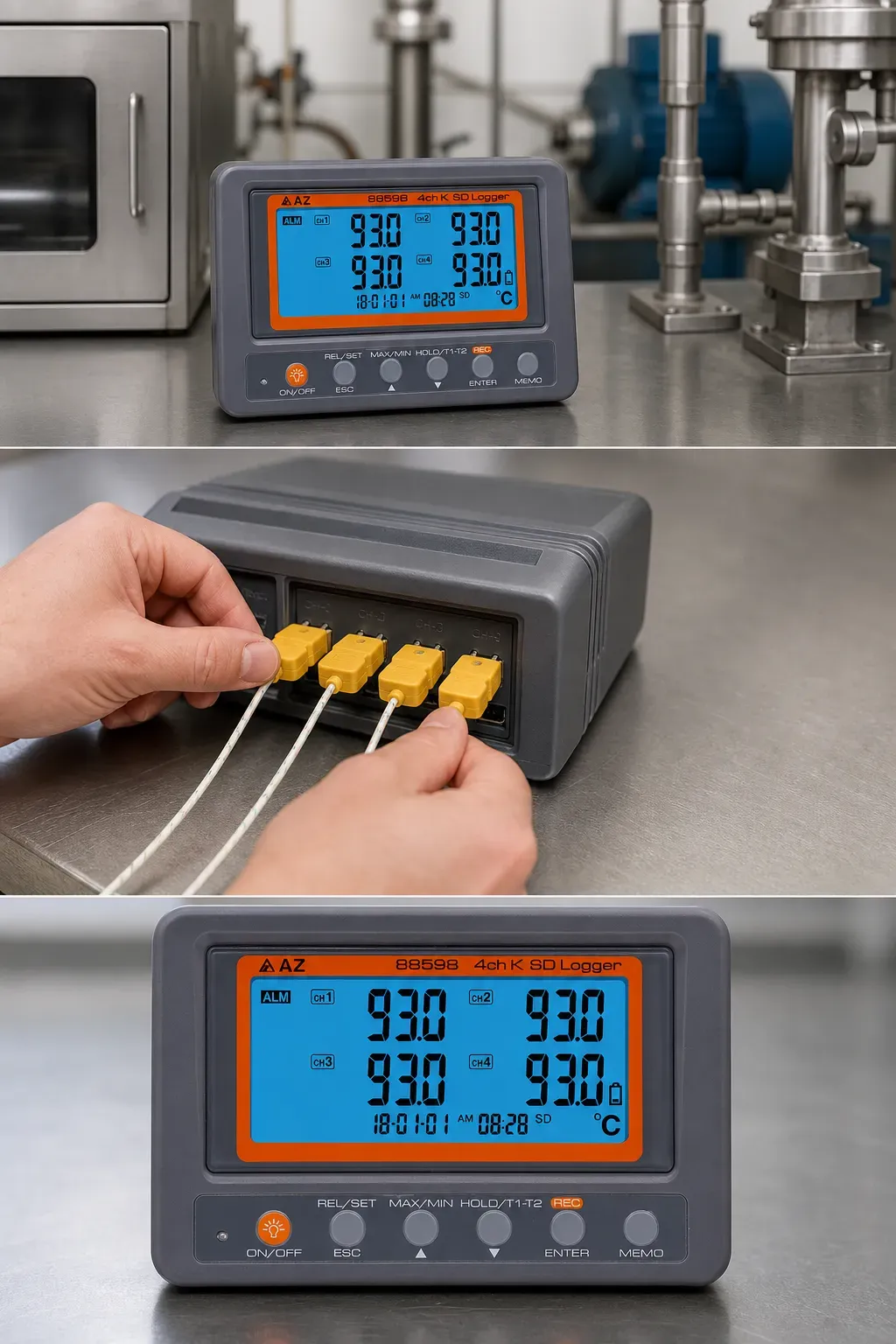
TL;DR: An SD card temperature logger records temperature readings automatically to a removable SD card, so you can track trends, prove compliance and review time-stamped data without leaving a laptop connected. For most UK buyers, the best option is a unit with reliable accuracy, clear CSV-style exports, alarm functions and enough channels to compare several points at the same time.
Key Takeaways
- An SD card temperature logger records temperature readings directly to removable storage, making it easier to keep auditable records without needing a permanent PC connection.
- For UK users, the right model depends on logging interval, probe type, alarm functions, accuracy, file format, and how easily data can be reviewed for compliance or quality control.
- A 4 channel thermocouple thermometer and thermocouple data logger is especially useful when you need to monitor several points at once, such as flow and return lines, multiple test locations, or different positions within the same process.
- SD logging is practical for maintenance teams, laboratories, food operations, engineering environments and facilities managers who need straightforward record-keeping on site.
- When buying in the UK, look for clear specifications, replaceable K-type probes, alarm support, and dependable export of time-stamped records.
What is an SD card temperature logger?
An SD card temperature logger is a device that measures temperature at set intervals and saves those readings to an SD card for later review. In other words, it gives you an automatic, time-stamped record that is easier to audit, share and archive than handwritten notes or one-off spot checks.
This matters because many UK users need temperature records they can trust without leaving a computer attached to the instrument. Once readings are being used for maintenance evidence, audit trails, product checks or internal reporting, manual note-taking quickly becomes the weak point.
We see this most often in UK workplaces where staff need fast set-up, simple downloads and a clear record of what happened over time. The workflow is familiar: insert the card, set the interval, start recording, then remove the card and review the file. As a result, no specialist software should be needed just to open the data.
For buyers comparing options, the category can look deceptively simple. Some units are really spot-check thermometers with limited logging. Others are built for continuous monitoring, multi-point measurement and alarm-based oversight. If your work involves comparing more than one temperature point at the same time, a 4 Channel Thermocouple Thermometer & Thermocouple Data Logger gives a more useful picture than a single-input device. You can monitor four K-type points at once with SD logging, alarms and ready-to-use probes, which is often the difference between isolated readings and genuinely usable evidence.
How does an SD card temperature logger work?
An SD card temperature logger captures temperature readings at chosen intervals and stores them on an SD card as a time-based record. Although that sounds straightforward, the real benefit is the structure of the data. A good logger produces clear, time-stamped files that can be transferred easily for review, archiving or reporting.
Most buyers in this category are dealing with one of two jobs. The first is trend monitoring: checking how temperature changes over hours or days. The second is comparative monitoring: checking whether several points behave the same way or drift apart. A single-point logger can manage the first job; however, a four-channel logger is much better for the second.
Why does removable SD storage still matter?
Cloud systems and networked sensors have their place, but SD logging remains useful because it is independent, portable and easy to adopt in existing workplaces. A site team can deploy the unit without changing the network, installing gateways or requesting IT access. Consequently, it is especially valuable in plant rooms, workshops, temporary test rigs, maintenance call-outs and older buildings where infrastructure is limited.
It also reduces friction when records are needed quickly. In many cases, staff simply remove the card, open the file and review the temperature history. For smaller businesses, estates teams and independent service engineers, that simplicity is often the deciding factor.
What is the difference between a temperature logger and a handheld thermometer?
A handheld thermometer gives an instant reading. An SD card temperature logger gives a timeline. Therefore, that distinction matters when faults are intermittent, seasonal or load-dependent. A single spot reading might look normal while the system has actually been drifting out of range overnight or during peak use.
With four channels available, you can compare inlet and outlet temperatures, verify heat distribution across equipment, or monitor separate locations at the same time. As a result, the logger becomes more than a record-keeping tool; it also becomes a practical diagnostic instrument.
Why do UK buyers use an SD card temperature logger?
In the UK, temperature logging is closely tied to practical accountability. Healthcare teams, facilities managers, food businesses, building services contractors and test engineers all need records that stand up to scrutiny. Therefore, a digital trace is usually easier to defend than a clipboard full of handwritten numbers.
There is also a clear compliance angle. According to UK guidance, proper temperature control and dependable record-keeping matter in clinical, food and regulated working environments. The NHS, for example, places strong emphasis on suitable storage conditions for temperature-sensitive medicines, including ongoing monitoring and accurate records where required in clinical settings. That wider discipline has influenced expectations well beyond healthcare.
Food businesses face a similar reality. According to the UK Food Standards Agency, chilled food should usually be kept at 8C or below, and many businesses work to tighter internal limits for safety and quality control. A logger helps prove whether storage or process temperatures remained within target rather than relying on occasional manual checks alone. Source: UK Food Standards Agency.
Based on our testing with multi-point thermocouple logging in UK site conditions, buyers usually value three things most: dependable time stamps, simple file export and the ability to compare several temperature points at once without adding extra devices.
What are the most common UK use cases?
- Monitoring heating and hot water system performance in commercial buildings
- Checking four separate K-type points on plant, pipework or HVAC assets
- Recording test temperatures in engineering, electronics and product development
- Supporting cold storage checks in pharmacies, laboratories and food environments
- Investigating intermittent overheating or poor thermal balance on site
For many of these jobs, a four-channel unit is not a luxury. Instead, it is the practical minimum needed to compare readings properly.
Is a 4 channel SD card temperature logger better than a single-channel model?
In many real-world jobs, yes. Buyers often start by looking for the cheapest logger and only later realise they need more than one measurement point. That tends to lead to workarounds, repeat visits and messy record-keeping. If you already know that comparison matters, choosing a four-channel model from the start is usually the better decision.
ChannType's main product focus is a 4 Channel Thermocouple Thermometer & Thermocouple Data Logger designed to monitor four K-type points at once, with SD logging, alarms and ready-to-use probes. For UK users, that combination is useful because it removes common setup barriers and makes side-by-side temperature comparison much easier.
When do you need four temperature channels?
- When you need to compare flow and return temperatures at the same time
- When you are checking several locations in one asset or process
- When you need stronger fault-finding evidence rather than isolated readings
- When you want one time-synchronised record instead of multiple separate devices
What are the advantages of a 4 channel thermocouple data logger?
A four-channel logger gives broader visibility, cleaner records and faster diagnosis. Instead of moving one probe repeatedly and trying to compare readings taken at different times, you can capture four points together under the same conditions. Consequently, the resulting data is more useful for maintenance, commissioning, testing and reporting.
What should you look for when buying an SD card temperature logger in the UK?
Although many models appear similar on paper, the buying details matter. For UK users, the right choice depends on how the logger will actually be used on site, how easy the files are to review, and whether the instrument supports the probes and alarm functions your work requires.
How important are accuracy and probe type?
Accuracy matters because logged data is only useful if the readings are credible. Equally, probe type matters because not every application uses the same sensor. K-type thermocouples are popular in engineering and facilities work because they are versatile, widely available and well suited to a broad temperature range.
What file format should an SD card temperature logger use?
For most buyers, a simple export format is best. Files that can be opened easily for review, sorting and archiving reduce friction and make it easier to share results internally. In practice, the logger should produce records that are straightforward to inspect without relying on awkward proprietary software.
Do alarm functions matter on a temperature logger?
Yes, particularly when you are monitoring critical limits or diagnosing intermittent faults. Alarms can highlight excursions as they happen, which is helpful during testing, maintenance visits or process checks. As a result, they turn the logger into a more active monitoring tool rather than a passive recorder.
Should you choose a handheld logger or a fixed monitoring system?
That depends on the job. A handheld SD card logger is often the better fit for mobile engineers, temporary investigations, commissioning work and ad hoc checks across several sites. By contrast, fixed systems suit permanent monitoring points where networked infrastructure and ongoing integration are already in place.
Is an SD card temperature logger suitable for compliance and audits?
Yes, provided the instrument is used correctly and the records are complete. An SD card temperature logger can support audit trails by creating a time-stamped history that is easier to retain and review than manual notes. However, the logger still needs appropriate settings, suitable probes and a sensible logging interval for the application.
According to UK expectations around record-keeping in sectors such as healthcare, food handling and facilities management, evidence needs to be clear, consistent and retrievable. Therefore, buyers should think about the whole record process: how readings are captured, how files are stored, and how staff will review or present them later.
Frequently asked questions about SD card temperature loggers
What is an SD card temperature logger used for?
It is used to create an automatic, time-stamped temperature record for monitoring, diagnostics, compliance support and reporting. Common UK uses include HVAC checks, plant testing, cold storage monitoring and engineering development work.
Can an SD card temperature logger work without a computer?
Yes. That is one of its main advantages. The logger records directly to the SD card, so it can be used on site without a permanent PC connection. Afterwards, the card can be removed and the data reviewed elsewhere.
Are thermocouple probes a good choice for temperature logging?
In many engineering and facilities applications, yes. K-type thermocouples are especially common because they are practical, replaceable and suitable for a wide range of measurement tasks.
What is the best SD card temperature logger for comparing several points?
For comparison work, a four-channel unit is usually the stronger choice because it lets you monitor several points simultaneously under the same conditions. That produces clearer evidence than moving a single probe between locations.
Ready to try ChannType?
Shop Now — £134.99